
Your Neighborhood Already Has a Score. You Just Can’t See It.
The surveillance infrastructure is already built. It’s already scoring you. And the same data that over‑polices your neighborhood is starting to influence whether you get a mortgage.

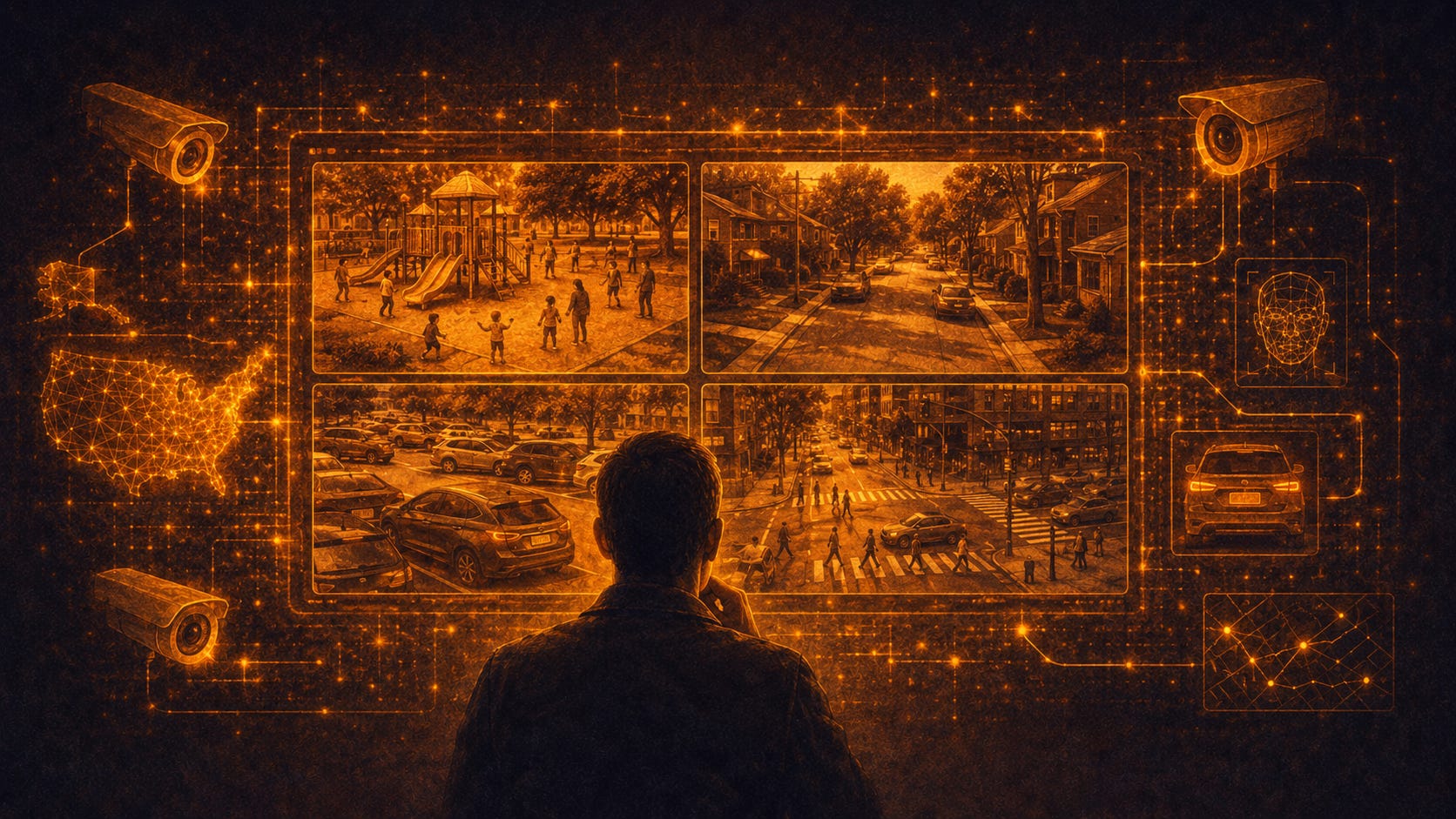
In early 2026, a security researcher ran a simple search query and found something that should have been impossible: live video feeds from AI‑powered surveillance cameras deployed across the United States, exposed on the open internet. No password required. No authentication at all.
Among the footage reportedly accessible to anyone with a browser: children on a playground.
The cameras belonged to Flock Safety, one of the fastest‑growing surveillance technology companies in the country. Their Condor pan‑tilt‑zoom cameras had been left wide open, allowing anyone who found them to view live feeds and access stored footage. Public reporting and follow‑up statements indicate that dozens of cameras were affected. Senator Ron Wyden called for a federal investigation. Flock described the issue as a “limited misconfiguration.”
The Network You Didn’t Know You Were Part Of
Let me be specific about what already exists.
Flock Safety markets a nationwide network of automated license plate readers and cameras used by thousands of law enforcement agencies and communities across 49 states. Company materials and recent coverage describe tens of thousands of cameras photographing vehicles that pass, logging the plate, time, location, and vehicle characteristics, and processing billions of scans each month.
Those cameras aren’t just reading plates. Flock’s “Investigations Manager” tool supports convoy searches that identify vehicles frequently seen together, searches that track vehicles across jurisdictions, plain‑language queries like “blue Honda with roof rack,” plate‑swap detection, and hotspot alerts. Through its acquisition of drone startup Aerodome, Flock is also building a “drone as first responder” program that aims to launch in dozens of cities.
Public estimates suggest that Flock’s valuation climbed to around 8.4 billion dollars in 2026, up from several billion just a few years earlier, with reported annual recurring revenue in the hundreds of millions and rapid year‑over‑year growth.
Over the course of 2025, the Electronic Frontier Foundation obtained data representing tens of millions of Flock searches logged by thousands of agencies nationwide. These records did not only concern serious crimes. EFF documented searches linked to political demonstrations, surveillance of people seeking reproductive healthcare, and queries that appeared to target Romani communities. Their review concluded that the problems they found were not isolated misuses but predictable outcomes of how the system is designed and deployed.
The Cameras Know Where You Live. That’s Not an Accident.
In late 2025, a federal judge unsealed the locations of hundreds of Flock cameras in the Hampton Roads region of Virginia. Researchers at Christopher Newport University mapped 614 cameras across the area and compared their locations to neighborhood demographics.
What they found should stop you cold.
The study reported that majority‑Black census tracts had roughly four times the camera density of majority‑white tracts, with ratios rising even higher in the most segregated areas. Eight of the ten most‑surveilled census tracts were majority‑Black. High‑poverty tracts had more than twice as many cameras as low‑poverty tracts; most high‑poverty tracts had at least one camera, while fewer than half of low‑poverty tracts did.
The densest cluster sits around Norfolk State University, Virginia’s only public historically Black university south of Richmond. One of the researchers, Professor Steven Keener, summarized it this way: there is effectively no way to get on or off that campus without passing a Flock camera.
A separate analysis in Oak Park, Illinois, found that a large majority of traffic stops triggered by Flock alerts involved Black drivers, despite Black residents making up a minority of the local population. An investigation reported that about 84 percent of such stops were of Black motorists in a village that is roughly one‑fifth Black.
Nobody sat down to draft this as an explicit racial surveillance plan. The cameras were placed where police departments said crime was highest. But “where crime is highest” is itself a conclusion drawn from decades of over‑policing the same communities. The camera placement inherited that pattern. Now it generates the data that confirms the pattern. The loop closes before anyone realizes it was a loop, not an objective fact about those neighborhoods.
And that loop doesn’t stay in policing. The same data flows outward: into insurance pricing, property valuations, rental screening, and mortgage decisions. I’ll come back to that.
Your Healthcare Data Has a Confidence Score
In January 2026, 404 Media published internal documents about a tool called ELITE—Enhanced Leads Identification & Targeting for Enforcement—developed by Palantir for U.S. Immigration and Customs Enforcement. ELITE presents agents with a map of potential deportation targets, assembles a digital dossier for each person, and assigns an “address confidence score” that indicates how likely it is that someone can be found at a given location. One example in the user guide shows a score of 98.95 out of 100.
According to reporting and civil liberties advocates, the data feeding this system includes information from the Department of Health and Human Services, such as Medicaid enrollment data, alongside records from U.S. Citizenship and Immigration Services and commercial data brokers like Thomson Reuters’ CLEAR.
People who signed up for Medicaid—for healthcare—have their addresses pulled into a system that helps the government score how confidently it can locate them for enforcement operations. Senator Ron Wyden and other lawmakers have criticized this practice, comparing the app to a consumer tool that lets you find the nearest coffee shop, except the goal is to find people to deport.
More than twenty state attorneys general joined lawsuits challenging this kind of data sharing. In late 2025, a federal court partially blocked aspects of the program, then allowed some limited sharing to continue. As of early 2026, in states that sued, basic biographical data can still be shared under certain circumstances for individuals the government believes are not lawfully residing in the U.S. In states that did not sue, there are no comparable court‑ordered limits.
The Security Is Already Broken
This infrastructure isn’t just ethically compromised. It’s technically compromised.
The Flock cameras that ended up streaming playground footage to the open internet did so without meaningful protections. No proper authentication and inadequate access controls until the issue was discovered, and the company pushed a fix.
In late 2025, lawmakers and journalists raised concerns that Flock did not universally require multi‑factor authentication for its law‑enforcement customers. Some agencies had not enabled MFA at all, and credentials associated with police systems have been found for sale on cybercrime forums. That combination creates an obvious risk: unauthorized access to a nationwide, real‑time location database.
Litigation in California has alleged that Flock data in San José was searched millions of times in a matter of months, including by agencies outside the city. Public records and local reporting show that cities such as Mountain View shut down or suspended their Flock systems after audits revealed access by federal agencies that had not been explicitly approved, including the Bureau of Alcohol, Tobacco, Firearms, and Explosives and other entities.
This is a nationwide surveillance network treating basic cybersecurity and access governance as negotiable line items. And at least dozens of cities have taken notice. Places including Austin, Cambridge, Denver, Mountain View, Evanston, Oak Park, and other localities have canceled or declined Flock contracts since 2025, citing a mix of privacy concerns, data‑sharing with federal immigration authorities, and security failures.
Flock’s response in the same period: rapid expansion into new jurisdictions, a multibillion‑dollar valuation, and hundreds of additional contracts. For every city that says no, dozens say yes.
What I See From Inside the Infrastructure
I manage technology infrastructure for a global academic community. When I evaluate vendors, I look for access controls, clear data‑retention policies, auditable trails of who did what, and strong encryption as a baseline.
What I see in the public descriptions of Flock’s architecture, and in the investigations that have surfaced around it, would fail a basic vendor security review in most regulated industries. Until recently, multi‑factor authentication was not enforced everywhere. Exposed camera feeds revealed gaps in basic configuration and monitoring. Policies allow retention periods to be set by individual agencies with no independent oversight, and data can be shared across jurisdictions in ways that the originating department and certainly the people being surveilled may not fully understand.
This isn’t just one vendor’s failing. It’s a design philosophy. The surveillance infrastructure was built for speed and scale, not for accountability. And now it’s generating the raw material that will feed financial algorithms, property valuations, and insurance pricing for decades.
What I Don’t Have Answers To
I don’t have a clean answer for the legitimate public‑safety use cases. Flock’s tools have been used to help solve serious crimes, recover stolen vehicles, and locate missing people. The cities that cancel contracts still have residents who want to feel safe, and some of those residents support these systems. I don’t know how to reconcile the genuine value of the tool with the documented harms embedded in its architecture.
I also don’t know exactly where the Fourth Amendment line falls. In January 2026, a federal judge sided with the city of Norfolk in a lawsuit over Flock cameras, finding that the system as currently deployed there did not violate the Constitution, while warning that the balance “could conceivably tip the other way” if the network expands or is used differently in the future. We are litigating the boundaries of this technology in real time.
And I worry about the equity of resistance. The cities that have successfully pushed back on Flock contracts and similar tools are disproportionately affluent, politically organized, and often whiter than the communities that endure the heaviest surveillance. The neighborhoods most saturated with cameras are often the least likely to have the legal resources and political infrastructure to fight them.
The Score Doesn’t Stay in Policing
Here’s what I keep coming back to.
The cameras go where police say crime is. That generates data—alerts, stops, incidents. Over time, that data aggregates into an informal neighborhood “score”: how risky this area is, how often things “happen” here. That score looks objective. It looks like math.
But it inherited every bias in the placement decisions and the history of enforcement. And the score doesn’t stay in policing.
Insurers use neighborhood‑level crime and risk measures when setting premiums. Property‑valuation algorithms draw on crime statistics and related signals. Tenant‑screening systems and background‑check products ingest data from police and court records, often purchased from the same brokers that feed law‑enforcement tools. Mortgage underwriters increasingly rely on automated valuation models and AI‑driven risk scores that are trained on historical lending and appraisal patterns.
The same data that puts four times as many cameras in your neighborhood can raise your insurance rates, lower your home’s appraised value, and flag your rental application. Not because a single underwriter or landlord woke up and decided to discriminate against you, but because the system was trained on a system that already did.
That’s the next piece: how surveillance data quietly feeds financial discrimination, and why the legal tools that could challenge it are being weakened at exactly the moment AI is scaling the problem.
If you’re thinking about these questions too, how these scores move from street corners into spreadsheets and loan files, I hope you’ll subscribe so you don’t miss that follow-up.
Rachel Ankerholz is an IT Director who manages infrastructure for a global academic community. She writes about AI ethics, surveillance, accessibility, and who gets included, and who gets left behind, when we turn people and neighborhoods into data.